

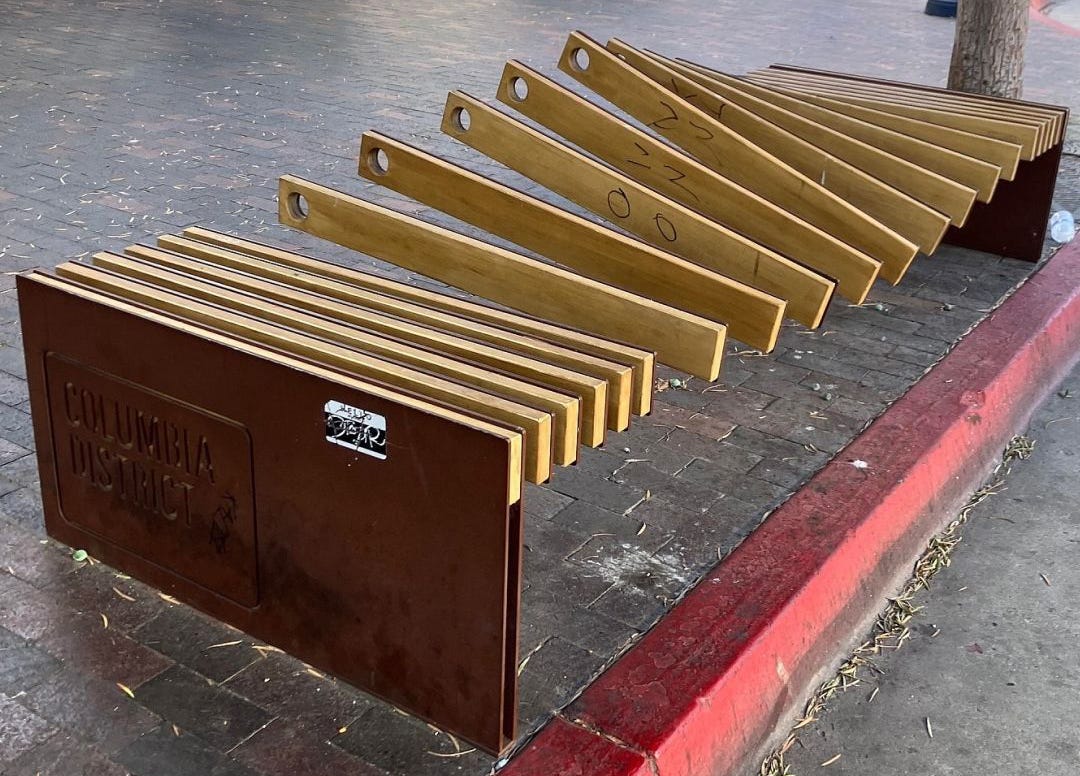
Have you ever heard of ‘Hostile Architecture’?
If not, it is public infrastructure (typically benches/seating) that is purposefully designed to be uncomfortable or not-easily useable especially for extended periods.
(there is also a version that is deployed against wildlife such as birds.)
Two Problems for the Price of One
Essentially, it was created to deter unhoused people from resting/sleeping in cities, in common public areas where people would see and be made to feel uncomfortable. Rather than actually helping them, or encouraging empathy, they are instead pushed out of society and effectively told ‘you aren’t welcome here’.
The problem with this, is that hostile architecture *punishes* EVERYONE not just the small subset of the population it is meant to affect.
So instead of addressing the *cause* of people becoming unhoused, they chose to build infrastructure which hurts EVERYONE, making cities less accessible and less welcoming. They created a new problem instead of fixing the existing one.
Now there are two problems instead of just one. Oops.
As I’ve been thinking about this, one of the things I acknowledge and address in my webinars is the fact that most buildings (especially in older cities) were built long before modern building codes and standards. So they don’t have ramps or elevators, or good signage to comply with AODA.
But they ALSO probably have bad lighting, are not built with acoustics in mind, maybe they don’t even have an HVAC system (let alone air filtration). They fail in pretty much every SOLACE Model (TM) metric.
Unlike with hostile architecture (which is a deliberate, intentional choice), these buildings were built ages ago and so I can’t blame the current owners for the sensory-unfriendly design.
But yes, it is ultimately ‘Sensory Hostile Infrastructure‘ (aka SHI, or ‘shy’).
Older commercial buildings are one thing, but institutional spaces suffer from this even more -hospitals being a prime example. There is nothing to enjoy about being in a hospital, even if you are only slightly unwell.
The lighting, the constant beeps and alarms and murmur (and sometimes patients yelling/moaning), the cold, the smells... it’s an absolute sensory nightmare, even for people without significant sensitivities.
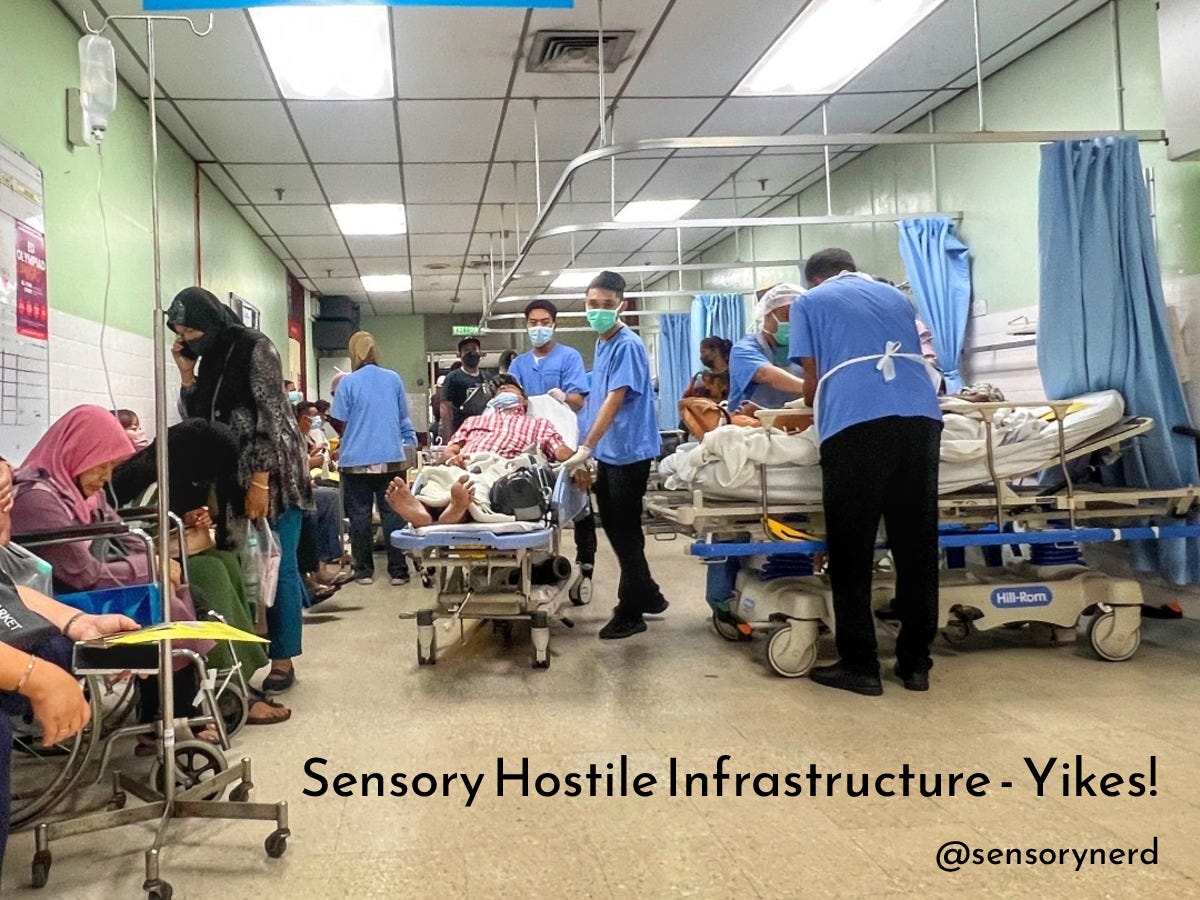
However, even many *modern* buildings aren’t designed with sensory accessibility/comfort in mind. And that results in human nervous systems being told ‘you’re not welcome here’.
The ‘solution’ that was chosen ended up being to create separate, dedicated spaces for people to retreat to for comfort (does that sound familiar?).
Just like hostile architecture is NOT the solution. (But I’ve already written about why sensory ‘quiet rooms’ are NOT a solution in my previous blog)
What Happens When You Address the Real Issue
We need to actually address the homelessness crisis - and there is a real and proven solution.
Traditionally, unhoused people are expected to deal with addiction, mental health, and get steady employment BEFORE they can get housing, but Finland realized that these things are much easier to achieve with safe, stable housing.
Finland pioneered a model called ‘Housing First‘, which flips the ‘traditional’ model on its head.
Imagine that - we’ve been doing something one way forever, and the results weren’t there. Someone tries something different, and they get positive results!
Now Norway, Denmark, and Austria have all integrated this ‘Housing First’ model with success.
More countries need to get on board.
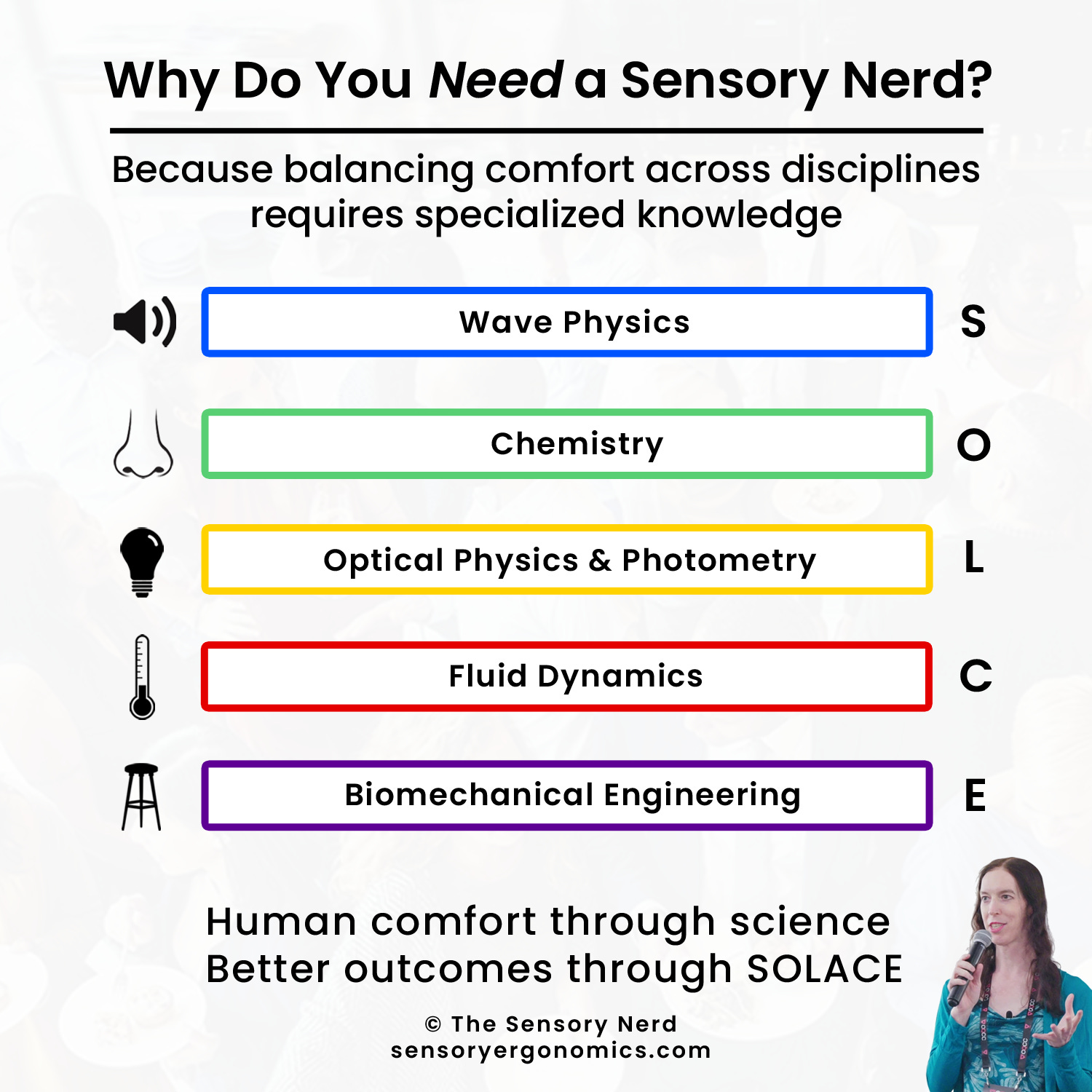
What I propose with the SOLACE Model (TM) is the same idea. Flipping the script, changing what isn’t working and using better information and research to do better. It considers every sense - sound, olfactory/air quality, lighting, climate, ergonomics, and overall accumulation.
It’s effectively ‘Nervous System First‘.
Marketing Executive Denise Resnik calls it ‘neurological curb cuts’. I say ‘sensory curb cuts’ are a subset of that.
Here’s a refresh of a slide from my Overwhelm Stack Sequence series (”The Problem and Solution Timeline”)
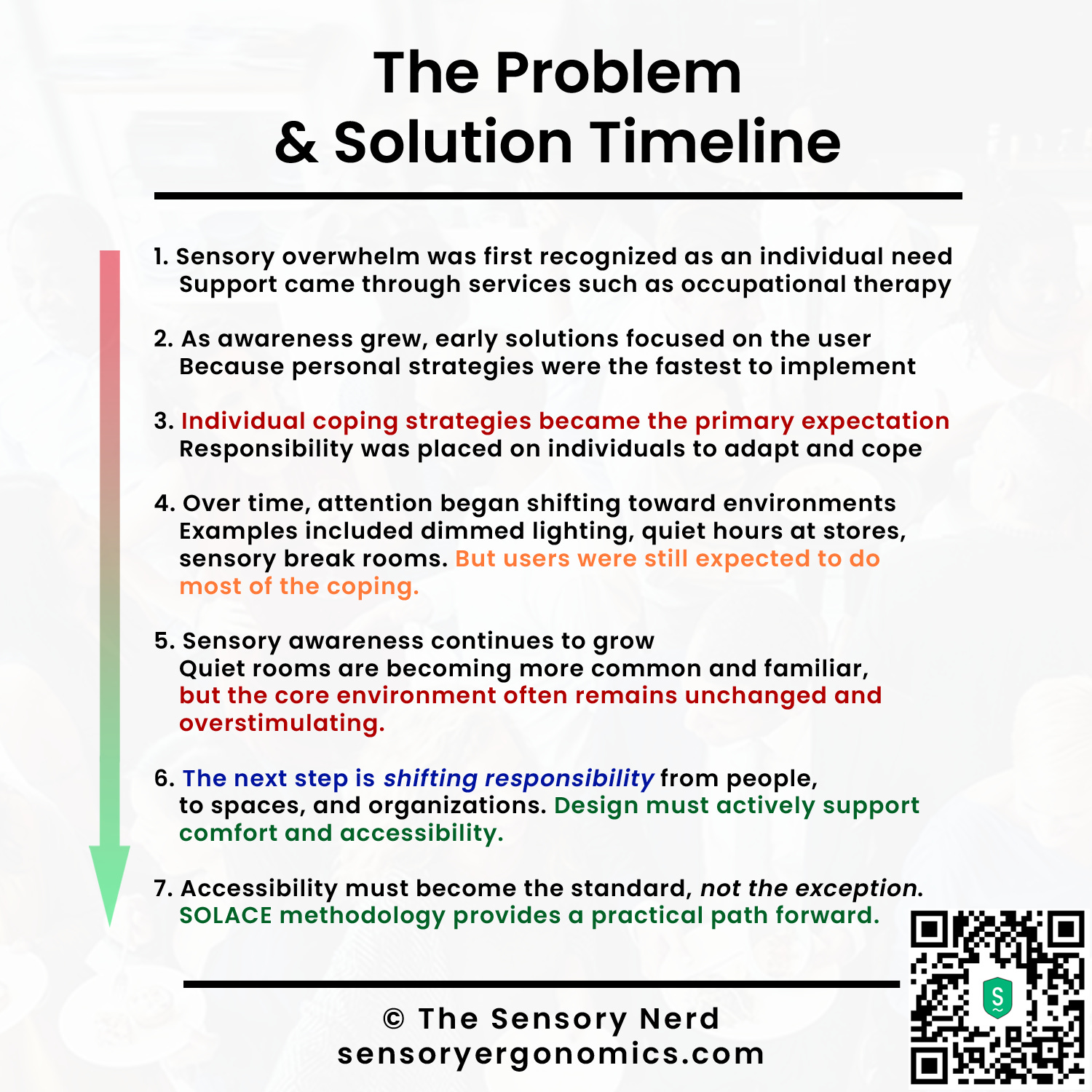
People who have struggled with sensory environments have been told to cope, to adapt, to self-regulate, or to get psychotherapy or occupational therapy to manage their stress.
OR, and hear me out here...
We could you know, FIX THE ENVIRONMENT?
As a former music producer, the analogy of getting the mix right for a song you’re recording is very apt. And the SOLACE Model was developed with that concept in mind. It’s about balance and harmony. Every space has a ‘sensory mix’, and most of them are not in harmonious balance.
This is why I say ‘SOLACE fixes the mix’.
The SOLACE Model is deliberately developed and designed to assess a physical environment, consider all the senses, and measure all the relevant factors, to identify the problem areas, and figure out ‘how can this be better’?
SOLACE relies on deeper science, not just decibels and lux levels.
Never fear, The Sensory Nerd is here to overthink the science so you don’t have to!
Let’s Get It Right, From Now On
The parallel is simple - hostile architecture forces certain people out of outdoor public space, and sensory hostile environments push people out of indoor public space.
We are forced to retreat to ‘quiet rooms’ (which leads to its own complications - see my previous blog). Or worse - just stay home entirely.
Both cases are examples of exclusion. One instance (hostile architecture) is much more intentional than the other, but the end result is the same.
Humans NEED connection, and it’s very hard to connect when your nervous system is being bombarded.
It’s time to make shared public spaces fully human-centric, and I specialize in doing that with indoor, primarily ‘social’ spaces.
Whether you manage an office, an event, a restaurant, or other - there’s SOLACE for that.
Ready to make it happen? get in touch - lacey@laceyartemis.com
Lacey Artemis (she/they) aka The Sensory Nerd is a neurodivergent speaker, consultant, and researcher focused on systems-level sensory inclusion and design. She is a pioneer of Sensory Ergonomics, where her applied research and advisory work supports more comfortable, sensory-accessible public spaces.
Lacey is autistic and ADHD and has sensory processing issues that affect her in a variety of ways.
Sensory Surveys • Whitepaper • SOLACE Model • LinkedIn • YouTube • IG • FB